Between one irrigation and the next, things do not always go the same way. Not even the same amount of time goes by. In winter, with the crop asking for very little, more than an hour can pass — sometimes a good deal more. In summer, in the middle of the day, it may not even reach half an hour.
And when the clock changes, so does the question. In summer there are two ways of getting it wrong: spacing the irrigations too far apart and running short of water, or pushing them too close together and running short of oxygen. In winter, with demand on the floor, water is rarely the problem; oxygen almost always is. That is what everything below is about.
A summer day
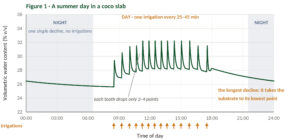 Figure 1. Moisture curve of a summer day in a coco slab. Illustrative sketch, not measured data. A winter day has far fewer teeth, and they are much further apart.
Let us start with a summer day, though it is worth saying up front that not every day looks like this one. On average the crop gets somewhere between seven and fifteen irrigations a day, of five to ten minutes each, depending on the crop and on the substrate. In winter that count drops sharply and the irrigations move apart.
The first one comes an hour or two after sunrise, once the plant is already working. The last one falls in mid-afternoon, well before the sun goes down, the idea being to leave the substrate as well aerated as possible for the night without the roots paying for it.
What comes out of that is a curve with plenty of teeth, but short ones: from one irrigation to the next the moisture gives up two, three or four points, no more. What follows is a different matter altogether. From the last irrigation of the afternoon to the first of the following morning there is a single decline, long and uninterrupted, and it is the only moment in the day when the substrate really reaches its lowest point.
Inside one interval
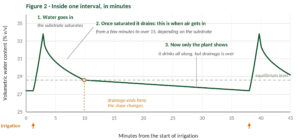 Figure 2. One interval expanded, in minutes. Illustrative sketch: the timings vary with the substrate.
The first thing that happens is that water goes in, and it lasts as long as the irrigation lasts. Moisture climbs almost vertically.
There is one detail worth knowing here, because it gets misread often. Water crosses the slab downwards in a matter of seconds, but spreading sideways takes it minutes. The probe registering the rise means the water has reached the probe. It does not mean the whole slab has been wetted evenly.
Then, once the substrate can hold no more, it starts to release. And this is where a fairly widespread misunderstanding needs clearing up: that stage does not last twenty or thirty minutes as a rule. It lasts as long as the material decides.
A fine substrate draws a far less steep fall and can take several minutes, more than fifteen even, before it is done. A coarser one settles it in a few minutes, simply because its pores are larger and empty sooner. This is worth keeping in mind when scheduling irrigations and when checking drainage, because the same interval can be generous for a coarse slab and too short for a fine one.
Once drainage runs out, the only thing still pulling the curve down is what the crop takes. That is why, from that point on, the slope can be read as how much it is consuming. And if the interval is stretched too far, you end up reaching the substrate’s dry-down point, which is where the plant starts to struggle.
There is one idea running through both stages that is worth holding on to: every drop that drains and every drop the plant takes up is a little air getting into the substrate. That air is what keeps the environment around the root in good order. Which is why drainage is not wasted water. And why a slab that is never allowed to dry never quite renews the air it holds inside either.
The question to put to the curve
With all of that on the table, the most useful check a probe allows fits into one line: does the tooth flatten out before the next irrigation comes in?
If it flattens, the slab has finished draining and air has got in. If the next irrigation catches it still falling, it has not finished. And that is not a problem of too much water, but of too little air.
In summer it costs more, because heat makes the root respire harder and warm water carries less dissolved oxygen on top of that. In winter the flattening is slow to arrive for a different reason: the plant barely pulls at the water and the substrate has to dry almost on gravity alone. That is where an over-fine material stays wet for hours.
And meanwhile, salts build up
There is something else going on in that stretch that the moisture curve does not show. The plant drinks water faster than it takes up some of the nutrients, so the solution left around the root gradually loads with salts.
The longer the interval, the more it shows. Which is why drainage and outgoing EC are read alongside moisture, and not instead of it.
If I change the irrigation, what happens to the curve?
Give more water per irrigation and the tooth climbs higher, with a sharper initial fall. There will be more drainage too, and if we overdo it a good share of that water will leave the slab without having served any purpose.
Give less and the tooth barely lifts. It may be enough to replace what has been used, but it may fall short both for wetting the whole volume and for leaching salts.
Increase the number of irrigations and the teeth get shorter while the whole curve rises: the slab works wetter and steadier. That is what you want when demand is pressing, as long as there is still time to drain and we do not end up with the roots in too much water and too little oxygen.
Reduce it and the opposite happens — deeper teeth, more air getting in. But it is not worth reaching the point where the plant has to work hard to pull the water out.
And there is a line best not crossed. If the slab dries out badly, the next irrigation no longer leaves it as it was: the peaks start coming down.
Here is what is going on. When the substrate loses a lot of water, air works its way to the bottom of the pores. On re-wetting, part of that air stays trapped and the water cannot push it out, so it cannot fill the whole space either. It fills eighty or ninety per cent of what is available, not a hundred. 
In practice this shows up in a very specific way: after a hard dry-down, even if the irrigation is lengthened, the probe no longer reaches its usual maximum. It is not that the dripper has failed. It is that the slab no longer takes in as much water as before, and it will take it back gradually, irrigation by irrigation rather than all at once, at a pace that depends on the substrate.
Coco helps here. The sector’s reference manual notes that, unlike other materials in common use, it rarely turns water-repellent and needs no wetting agents. In rehydration trials, starting from fifty per cent moisture, it recovered its full capacity in a single irrigation, while other materials without a wetting agent did not manage it in ten. Even so, there is no room for complacency: below thirty per cent no organic material recovers well.
Five checks
- Does the curve rise clearly with every irrigation? If it barely moves, time to check dripper and dose.
- Can the drainage fall be told apart? That is the part putting air in, and how long it lasts depends on the substrate.
- Does it flatten out before the next irrigation? The key check, particularly in summer.
- Do the teeth look like one another? If one drops much further than the rest, either a dripper has failed or demand has shot up.
- Is the overnight decline properly sized? The last irrigation has to leave the slab ready for twelve hours: aerated, but without punishing the root.
One warning about the instrument. Probes usually come factory-calibrated for soil, not for coco, so the absolute figure is not to be trusted until it has been calibrated for that substrate. What does work is the shape of the curve and how it shifts from one day to the next. Watch trends, and back them up by touching or looking at the substrate.
Because there is no single moisture percentage that works for every slab. What there is, is a pattern that repeats — and that can be learned to read.
 Where these data come from
Raviv, Lieth and Bar-Tal (2019), Soilless Culture: Theory and Practice, 2nd ed., Elsevier, chapters 3, 8 and 9: vertical and lateral movement of water, air entry during drainage, salt build-up between irrigations and the behaviour of coco. Baixauli and Aguilar (2002), Cultivo sin Suelo de Hortalizas, Generalitat Valenciana, for management by periods of the day. Technical guide: Irrigation and Fertigation of Hydroponic Blueberry in Agadir, for pulse frequencies and durations. Fields, Fonteno and Jackson (2014), HortScience 49(3), for the comparison of rehydration between materials. The figures are sketches: they illustrate the shape of the curve, and neither reproduce measured values nor constitute a recommendation on dose or frequency.